
Can I Replace Just One Panel on My Garage Door? Here’s the Quick Answer
Can I replace just one panel on my garage door? Yes — in many cases, you can. If the damage is limited to a single section, your door is a standard sectional design, and the manufacturer still makes your model, a single panel swap is a real, practical option.
Here’s a quick summary of when it works — and when it doesn’t:
| Situation | Single Panel Replacement |
|---|---|
| Minor dent or cosmetic damage | Usually yes |
| Door is under 10-15 years old | Likely yes |
| Manufacturer still makes your model | Yes |
| Door is over 15 years old | Often not recommended |
| Multiple panels damaged | Usually no |
| One-piece (non-sectional) door | No |
| Model discontinued | Very difficult |
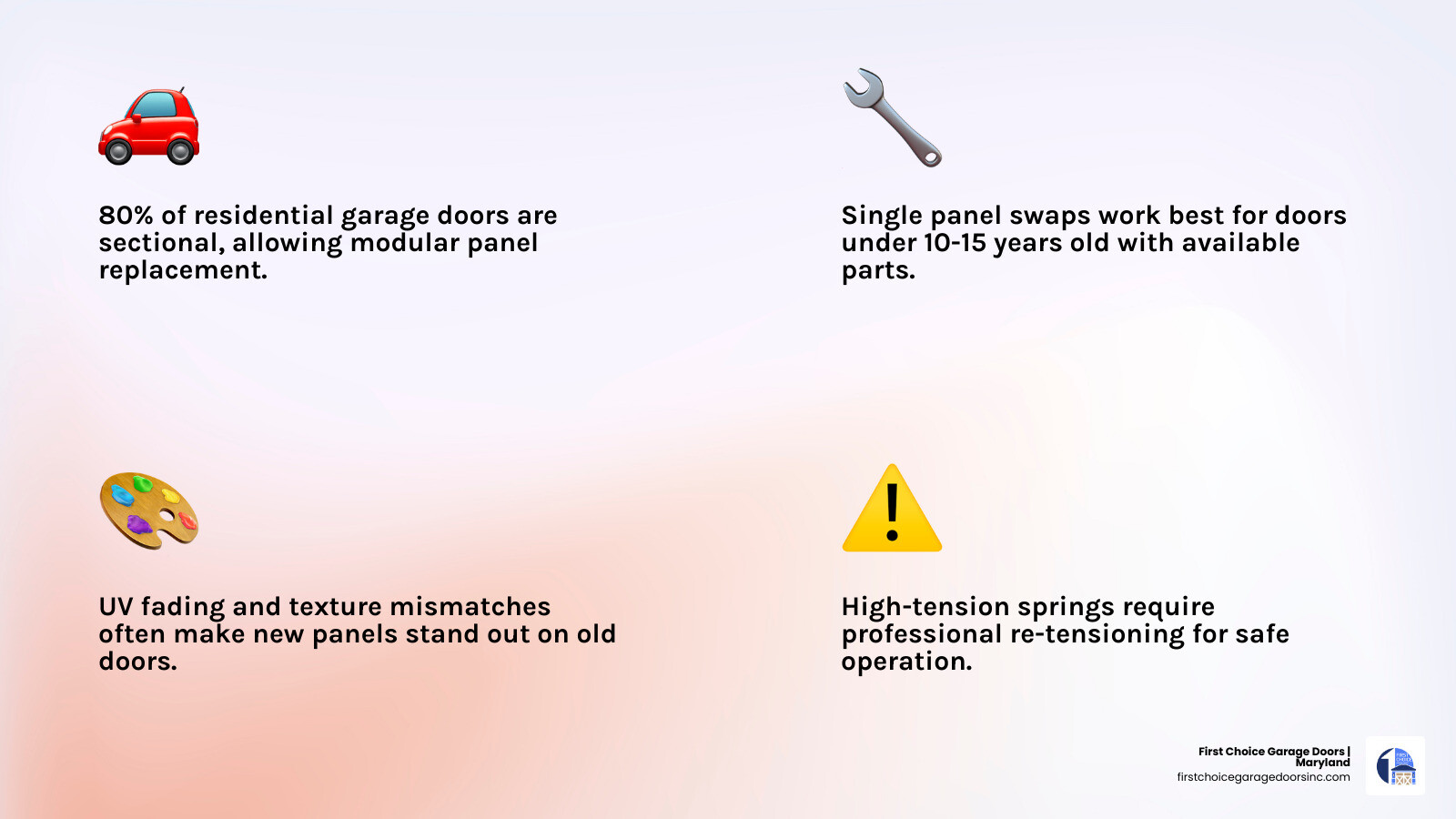
Sectional garage doors — which make up roughly 80% of residential installations — are designed in horizontal segments connected by hinges. That modular design is exactly what makes partial replacement possible at all. Each section can, in theory, be removed and swapped independently.
But “possible” and “straightforward” aren’t the same thing. The reality is a bit more nuanced. Color fading, discontinued parts, spring tension, and structural issues can all turn what looks like a simple fix into a much bigger decision.
This guide walks you through exactly what to check, what to watch out for, and how to know whether a single panel fix is the right call for your Maryland home.
Can I Replace Just One Panel on My Garage Door?
We hear this question all the time from homeowners in Columbia and Frederick. Perhaps you were backing out a little too quickly and caught the bottom section, or a stray basketball left a prominent dent right at eye level. When the rest of the door looks pristine, it feels wasteful to scrap the whole system.
As we mentioned, the answer to “can i replace just one panel on my garage door” is generally yes, provided the damage is isolated. If you have a sectional door, we can often unbolt the damaged section and slide a new one into its place. This is a common solution for vehicle impacts or cosmetic dings that haven’t warped the tracks or compromised the overall frame.
However, there is a major distinction between sectional doors and one-piece “tilt-up” doors. If your door is a solid slab that pivots outward in one piece, you cannot replace a “panel” because the door has no sections. In those cases, any significant damage usually necessitates a full door replacement. For the 80% of Marylanders with sectional doors, The Lone Ranger Can You Really Replace Just One Garage Door Section is a reality that can save you the headache of a full-scale renovation.
The key is structural integrity. If a dent is so deep that the panel is “V-ing” or buckling, it can put immense strain on the rollers and the opener. Replacing that single section promptly can prevent the “ripple effect” of damage from spreading to your expensive motor or the other healthy panels.
Assessing Your Door for a Sectional Swap
Before we order a part, we have to look at the “15-year rule.” Garage doors typically have a functional lifespan of 20 to 30 years, but the window for finding matching parts is much smaller. Manufacturers often retire specific styles, colors, or joint designs every 10 to 15 years. If your door was installed in the early 2000s, finding a panel that fits the unique tongue-and-groove or shiplap joint of your existing door can be like finding a needle in a haystack.
When we visit a home for an inspection, we look at several factors to determine if a swap is viable:
- Extent of Damage: Is it just the skin of the metal, or is the interior stile (the vertical support) broken?
- Hardware Condition: Are the hinges, tracks, and rollers still aligned, or did the impact bend the “skeleton” of the door?
- Model Availability: Is the manufacturer still in business and still producing this specific series?
Choosing Between Garage Door Repair Or Replacement often comes down to this assessment. If the door is over 15 years old, even if we can find a panel, it might not be the best investment. Older doors often have weakened springs and degraded insulation. Sometimes, seeing Signs You Need A Garage Door Replacement across multiple panels means a single-panel fix is just a temporary bandage on a system nearing retirement.
Identifying Your Model to See if You Can Replace Just One Panel on My Garage Door
To find out if a replacement is possible, we need to play detective. Garage door panels are not universal; they vary by thickness (usually 1-3/8″ or 2″), insulation type, and the way they interlock.
The most reliable way to identify your door is to find the serial number. On most doors manufactured in the last decade, you’ll find a sticker on the interior of the bottom or top section. This sticker usually contains a 15- to 16-digit serial number, the model number, and the manufacture date. If that sticker is missing, we often look for brand names stamped into the hinges or the handle. Having this information ready when you call us allows us to check manufacturer databases instantly to see if your specific section is still sitting in a warehouse.
The Technical Challenges of Partial Replacement
Even when the model is available, there is a hurdle that often surprises homeowners: the “Mismatch Dilemma.”
Think about your garage door’s life. It sits in the Maryland sun year after year. UV exposure is the primary cause of color fading. If you have a white door that has been baking in the sun for a decade, it isn’t “factory white” anymore; it’s likely a slightly chalkier, duller shade. When we install a brand-new, factory-fresh panel, it might “pop” visually, making the rest of the door look older than it did before.
Texture variance is another factor. Manufacturers occasionally update the woodgrain embossing or the “stucco” finish on their steel panels. Even if the color is close, a difference in texture can catch the light differently. Mastering The Makeover How To Blend New Garage Panels With Old Ones often requires a fresh coat of paint across the entire door once the new panel is installed to ensure a seamless look.
Furthermore, we have to consider insulation. If your old door has polystyrene (styrofoam) insulation and the new panel uses modern injected polyurethane, the R-value and weight will be different. This can lead to The Ripple Effect Of A Warped Garage Door Panel where the door doesn’t seal correctly against the weatherstripping, leading to drafts and energy loss.
Why Professional Alignment Matters When I Replace Just One Panel on My Garage Door
This is the part where we put on our “safety first” hats. You might see a few bolts and think this is a weekend DIY project, but garage doors are under extreme tension.
The torsion springs located above your door store enough energy to lift several hundred pounds of steel. When we replace a panel—especially the bottom or top sections—we have to manage that tension. If you unbolt a bracket while the spring is still active, it can snap with enough force to cause severe injury or property damage.
Beyond safety, there is the issue of balance. A garage door is a finely tuned machine. If the new panel has a different weight than the old one (due to different insulation or thicker steel), the door will be out of balance. An unbalanced door:
- Strains the garage door opener, potentially burning out the motor.
- Causes the cables to fray or jump off the drums.
- Makes the door “chatter” or shake as it moves through the tracks.
When we perform a panel swap, we don’t just bolt it in and leave. We re-tension the springs and perform a 25-point safety check to ensure the whole system is harmonized. Knowing When To Repair Vs Replace Your Garage Door involves understanding that a panel is part of a larger, high-pressure system.
When a Full Replacement is the Smarter Choice
While we love saving our customers money with a quick fix, there are times when we’ll look you in the eye and recommend a full replacement.
If you have damage to two or more panels, the math usually shifts. By the time you pay for multiple panels and the labor to install them, you are often very close to the price of a brand-new door. A new door isn’t just a cosmetic fix; it’s a “clean reset” for your home’s exterior.
Consider these benefits of going new:
- Return on Investment (ROI): Nationally, a new garage door replacement can yield an ROI of over 193%. It is one of the top home improvement projects for increasing resale value.
- Energy Efficiency: Modern insulated doors can reduce heating and cooling bills by 10% to 20%. If your old door is uninsulated, the energy savings alone can help pay for the new door over time.
- Warranty: A new door comes with a manufacturer’s warranty on the finish, hardware, and springs, giving you peace of mind that a single panel fix can’t match.
- Curb Appeal: If your door is 20 years old, a new carriage-house style or modern glass-panel door can completely transform the “face” of your home.
We often provide a The Cost Of A Facelift Panel Replacement Vs New Door Comparison so you can see exactly where your money is best spent. In Maryland’s humid climate, if your steel door is starting to show rust at the bottom of multiple panels, it’s usually a sign that the metal is failing from the inside out, and a new door is the only long-term solution.
Frequently Asked Questions about Garage Door Panels
Will a new panel perfectly match my old door?
In terms of model and “factory color,” yes—if the model is still in production. However, because of UV fading and weathering, the new panel will likely look brighter or cleaner than the older ones. For a perfect aesthetic match, we often recommend repanting the entire door after the replacement is complete.
Is it safe to replace a garage door panel myself?
We strongly discourage DIY panel replacement. Because the panels are connected to the high-tension spring system and heavy cables, a mistake can lead to the door crashing down or the springs snapping. Professionals use specialized tools like winding bars and locking pliers to secure the door safely during the swap.
What should I do if my door model is discontinued?
If the manufacturer no longer makes your panel, we can sometimes source a “close match,” but it rarely fits the joints perfectly. A poor fit can cause the door to bind in the tracks. In these cases, or if the manufacturer has gone out of business, a full door replacement is usually the only safe and functional option.
Conclusion
At First Choice Garage Doors, we believe in giving Maryland homeowners the straight truth. If we can save your door with a single panel fix, we will. If your door is a “Lone Ranger” that’s served its time and needs a full retirement, we’ll help you find a beautiful, energy-efficient replacement that fits your budget.
Whether you are in Easton, Columbia, or Frederick, don’t let a dented panel ruin your home’s curb appeal or compromise your safety. Our experienced technicians are ready to provide a professional inspection and a clear path forward.
Contact our team for expert garage door repair in Maryland today, and let’s get your garage door looking and performing like new again!